
Sending more emails doesn’t always lead to greater customer engagement.
Utility customers are inundated with messages every day. When communications aren’t relevant to their needs, interests or lifestyle, they can quickly become disengaged.
“Customers are receiving personalized experiences everywhere in their daily lives,” says Joe Pifher, Creative Director at Questline Digital. “These interactions are changing what they expect from their utility’s communications.”
This growing demand for personalized communications is changing the way utilities approach utility email marketing. Instead of one-size-fits-all messaging, utility communicators are increasingly leveraging segmentation, utility email personalization and customer data to deliver more meaningful customer experiences.
The Risk of a One-Size-Fits-All Approach
Today’s customers expect emails that are timely, relevant and tailored to their needs. In fact, research from McKinsey found that 71% of consumers expect personalized interactions, while 76% become frustrated when those expectations aren’t met.
When utilities rely on too many broad email campaigns, customers often begin ignoring emails, deleting messages without reading them or unsubscribing altogether.
“If you’re sending customers information they don’t need or want, you’re training them to ignore your emails,” Pifher says. “Eventually, the messages that do matter may go unseen.”
Improving utility email engagement begins with delivering communications customers actually want to receive. Research shows that email fatigue is an ongoing challenge for marketers. According to a recent study, 43% of consumers say the primary reason they unsubscribe from email lists is because they receive emails too often.
“Utilities often discover they don’t need to send more emails to improve engagement – they need to send more relevant emails,” Pifher says. “When customers consistently receive information that matters to them, engagement tends to follow.”
Utilities communicate about a wide range of topics, from financial assistance to electric rate plans. While these communications provide valuable information, not every message is relevant to every customer.
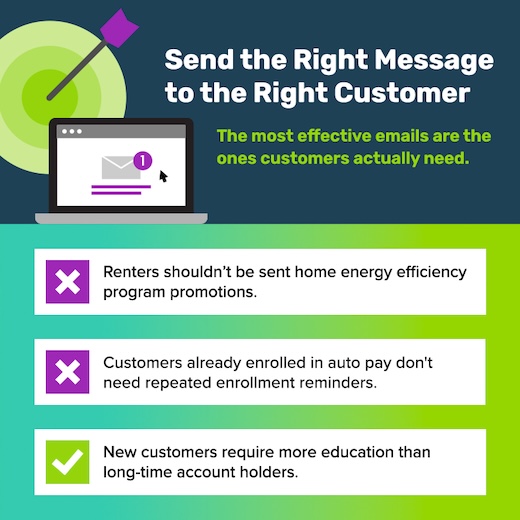
Before sending an email, utility communicators should ask, “Who will find this information most valuable?” This simple change in perspective helps them send smarter utility email marketing campaigns that are more likely to accomplish program goals and create a positive customer experience.
Reaching the Right Customers
Segmentation is one of the most effective strategies for improving utility email engagement. By organizing customers into groups based on shared characteristics, behaviors and interests, utilities can send fewer, more targeted emails.
“Segmentation doesn’t have to be complicated,” Pifher says. “It’s simply about making sure the people receiving a message are the people who will actually benefit from it.”
The impact of segmentation can be significant for companies. According to the Digital Marketing Association, 77% of email marketing ROI comes from segmented, targeted and triggered campaigns, demonstrating the value of delivering the right information to the right audience.
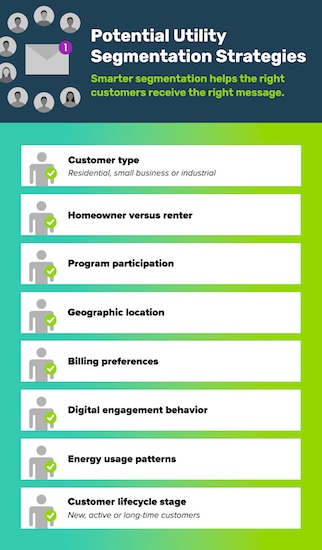
For example, customers who consistently engage with energy efficiency content will likely be interested in additional program recommendations. Customers with high energy usage patterns could benefit from energy-saving tips, budget billing options or home energy assessments. New customers need educational resources that help them understand account management tools, billing options and available utility programs.
The value of segmentation extends beyond utility email engagement metrics — it can also drive measurable program participation and business outcomes.
A large Midwest energy utility wanted to increase participation in its Demand Response program among commercial and industrial customers. Rather than sending a single message to all customers, the utility used a segmentation strategy, tailoring emails to prospective participants and previous program enrollees.
Prospective customers received educational content focused on program benefits, including cost savings, compensation opportunities and community impact. Previous participants received targeted reminders highlighting enrollment deadlines.
Through the segmented campaign, the utility achieved its 180-megawatt Demand Response nomination goal, exceeded enrollment expectations and reached participation targets ahead of schedule. This utility email marketing campaign demonstrates how segmentation can help utilities deliver more relevant communications while driving measurable program results.
Ultimately, segmentation helps utilities communicate with greater precision and maximize the impact of every message.
Sending More Relevant Emails
Many marketers think of personalization as simply inserting a customer’s first name into an email. While that tactic can help, today’s customers expect much more. Effective utility email personalization uses customer data to tailor messages to their unique needs, interests and behaviors.
“The message should speak directly to the customer’s situation,” Pifher says. “You don’t have to reinvent the entire email — you just need to make sure the most important parts – like the subject line, headline and introduction – are relevant to the audience receiving it.”
Utility email personalization can improve both customer engagement and program participation. One study found that personalized emails generated an 81.5% increase in click-through rates compared to non-personalized sends.
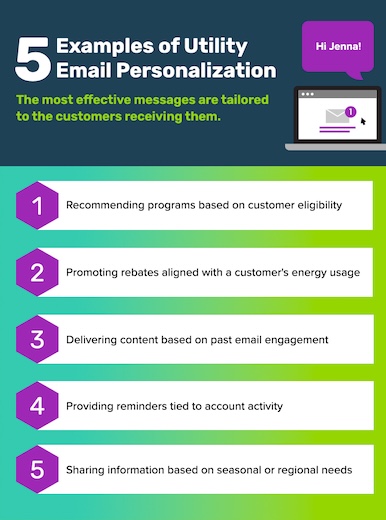
For example, a customer who recently purchased an electric vehicle may benefit from information about EV rates and charging infrastructure. Likewise, a customer struggling with high bills may be interested in budget billing or payment assistance programs.
Utility email personalization can be especially valuable when utilities need to explain complex topics. PSEG Long Island partnered with Questline Digital to help customers better understand new Time-of-Day (TOD) rates. The utility used personalized bill explainer videos that incorporated each customer’s actual bill data and energy usage patterns.
The videos provided tailored energy-saving recommendations, simplified TOD rates through clear visual explanations and helped customers better understand their energy costs.
The results demonstrated the power of personalized communications to improve understanding, build trust and help customers make more informed decisions. Nearly 93% of customers said the videos clearly explained bill components, and 92% found the information more helpful because it used their actual billing data. Additionally, 82% of customers said the personalized tips provided valuable cost-saving opportunities.
The Foundation of Targeted Communications
Successful utility email marketing is built on customer data. Segmentation and personalization are only possible when utilities effectively leverage the customer information they already have. Fortunately, many utilities have access to valuable insights that can help create more impactful communications.
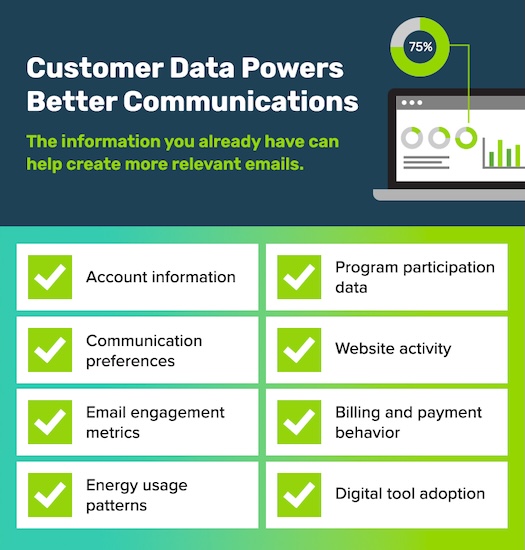
“Utilities are sitting on a gold mine of customer data,” Pifher says. “The challenge isn’t collecting the information, it’s understanding how to use it to create more relevant customer experiences.”
One of the biggest misconceptions in utility email marketing is that increasing email sends automatically improves customer engagement. In reality, customers are more likely to engage when communications feel valuable to their unique situation.
When utilities combine segmentation, personalization and customer data, the result is a more strategic approach to customer communications – one that benefits both customers and the utility.
“Personalization works hand in hand with segmentation,” Pifher says. “It’s really about removing the noise and making sure customers only see what’s relevant to them.”
Delivering More Value with Every Message
Utilities that embrace segmentation, utility email personalization and customer data are better positioned to meet evolving customer expectations. By focusing on relevance versus volume, utility communicators can create communications that strengthen long-term customer relationships.
“The future of customer engagement isn’t about sending more emails,” Pifher explains. “It’s about creating communications that are timely, relevant and useful for each customer.”